

All the data and models that will be acquired or developed during the project will be progressively listed in this section.
We are currently working on processing the data before making it open.
For the moment, datasets are available on request.
We are currently installing a IR thermal camera (FLIR A655sc) and an industrial VIS camera (DAHENG MER2, with known RGB response) on 12 ICOS sites across a latitudinal gradient over Europe.
Available data:
- Instantaneous IR & VIS images every 15 minutes
- 15 min-average IR images
- 10 second-average temperature of the scene (the thermal image is split in 4 quadrant and the average temperature of each quadrant is recorded in a text file)
- Temperature of the IR camera every 15 minutes
- Average temperature of the reference target with known emissivity every minutes
IR camera resolution: 640 x 480
VIS camera resolution: 2048 x 1536
Site preview (daily update)
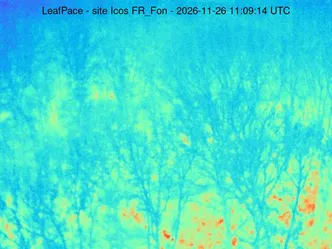
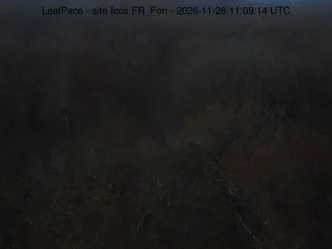
FR-Fon (France)
Starting date: 11/03/2025, orientation: West, North-West
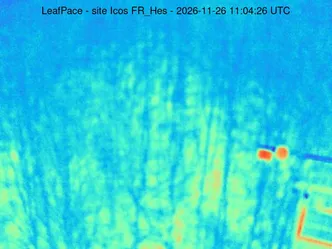
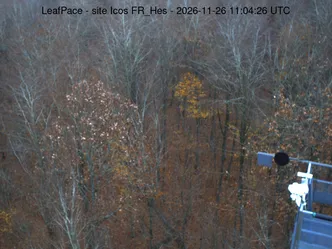
FR-Hes (France)
Starting date: 05/06/2025, orientation: West
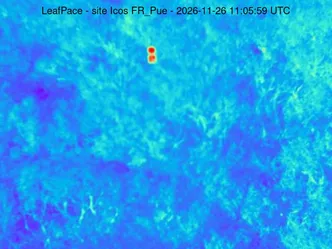
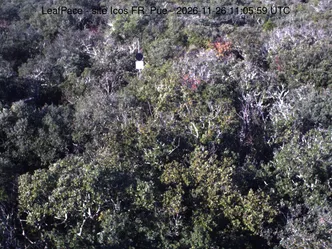
FR-Pue (France)
Starting date: 21/11/2025, orientation: West
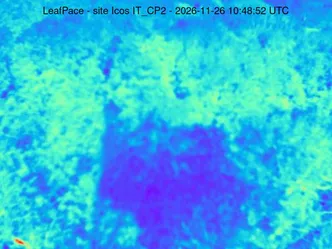
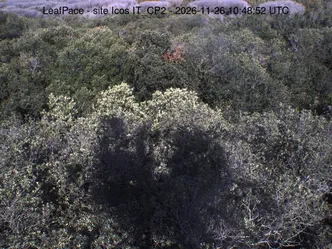
IT-CP2 (Italy)
Starting date: 28/04/2026, orientation:
DE-Hai (Germany)
Starting date: 09/06/2026, orientation West:
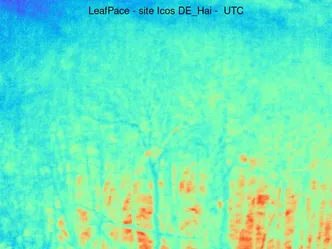
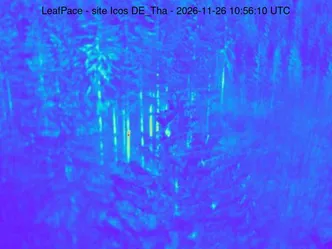
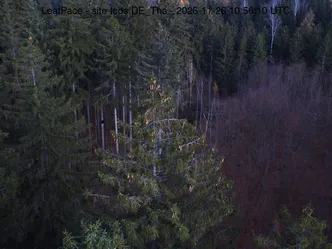
DE-Tha (Germany)
Starting date: 11/06/2026, orientation East:
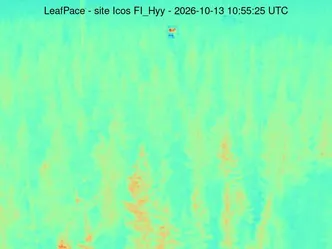
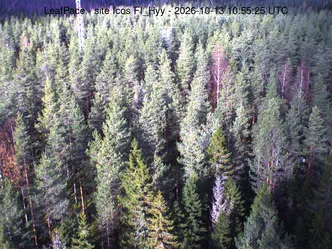
FI-Hyy (Finland)
Starting date: 15/07/2026, orientation North:
We are developing a trait database dedicated for understanding and calibrating the energy budget of buds. The measured traits are:
- Bud size (width, height, shape)
- Bud spectral properties (350nm-2500nm, NaturaSpec)
- Internal traits of the bud in cross-section (presence/absence of wool, position of meristem, etc.).
- Bud wet and dry mass
This database is associated with bud temperature for 12 species as well as microclimate observations for computing the energy budget of buds:
- Acer pseudoplatanus
- Alnus glutinosa
- Carpinus betulus
- Fagus sylvatica
- Fraxinus excelsior
- Fraxinus ornus
- Pinus sylvestris
- Populus nigra
- Quercus ilex
- Quercus pubescens
- Quercus robur
- Sorbus aucuparia
A database with concomitant observations for testing optimality theories at the leaf level :
- Leaf gaz exchange measurements + fluorescence (LI6800-PF)
- Leaf spectral properties (350-2500nm, NaturaSpec)
- Leaf traits (SLA, C, N, P, destructive measurements)
- Leaf N (non-destructive, SPAD-502plus)

MuSICA (Multi-layer Soil-vegetation-Atmosphere Continuum) is a process-based model designed to simulate the exchange of water, carbon dioxide, and energy within ecosystems. It explicitly represents complex vegetation structures, microclimate interactions, and multi-layer soil dynamics to capture the competition for light and water among multiple species. Applicable across a range of biomes, MuSICA operates at fine temporal resolution and supports long-term ecosystem simulations.

ORCHIDEE is the land surface model of the IPSL Earth System Model, designed to simulate interactions between the land and atmosphere. It can be run in a coupled mode with a global circulation model to assess how land surface changes influence climate and vice versa. Alternatively, it operates in stand-alone mode using atmospheric forcing data, allowing flexible simulations from global to local scales.
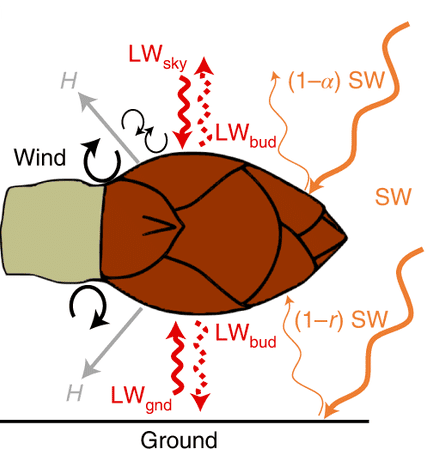
Bud energy model. This model is based on the tealeaves R package for simulating leaf temperature (Muir 2019) and was adapted by Peaucelle et al. (2022) to simulate the temperature of tree buds from climate data and bud traits.
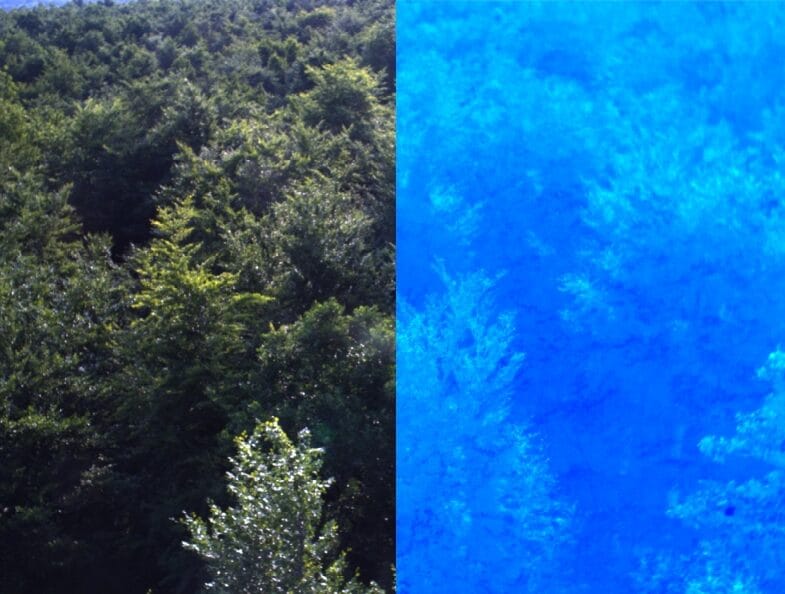
We are currently developing a set of scripts for the acquisition and processing of IR/VIS images acquired at ICOS sites. This includes python script for image acquisition, alignment, as well as models for extracting and analyzing the temperature of the different components of the scene (soil, wood, leaves), extract sun/shadow leaves and phenological indices.